The method, in the open
How we score a blind test.
The test is called a triangle test. Three glasses. Two are the same, one is different. You say which one is different.
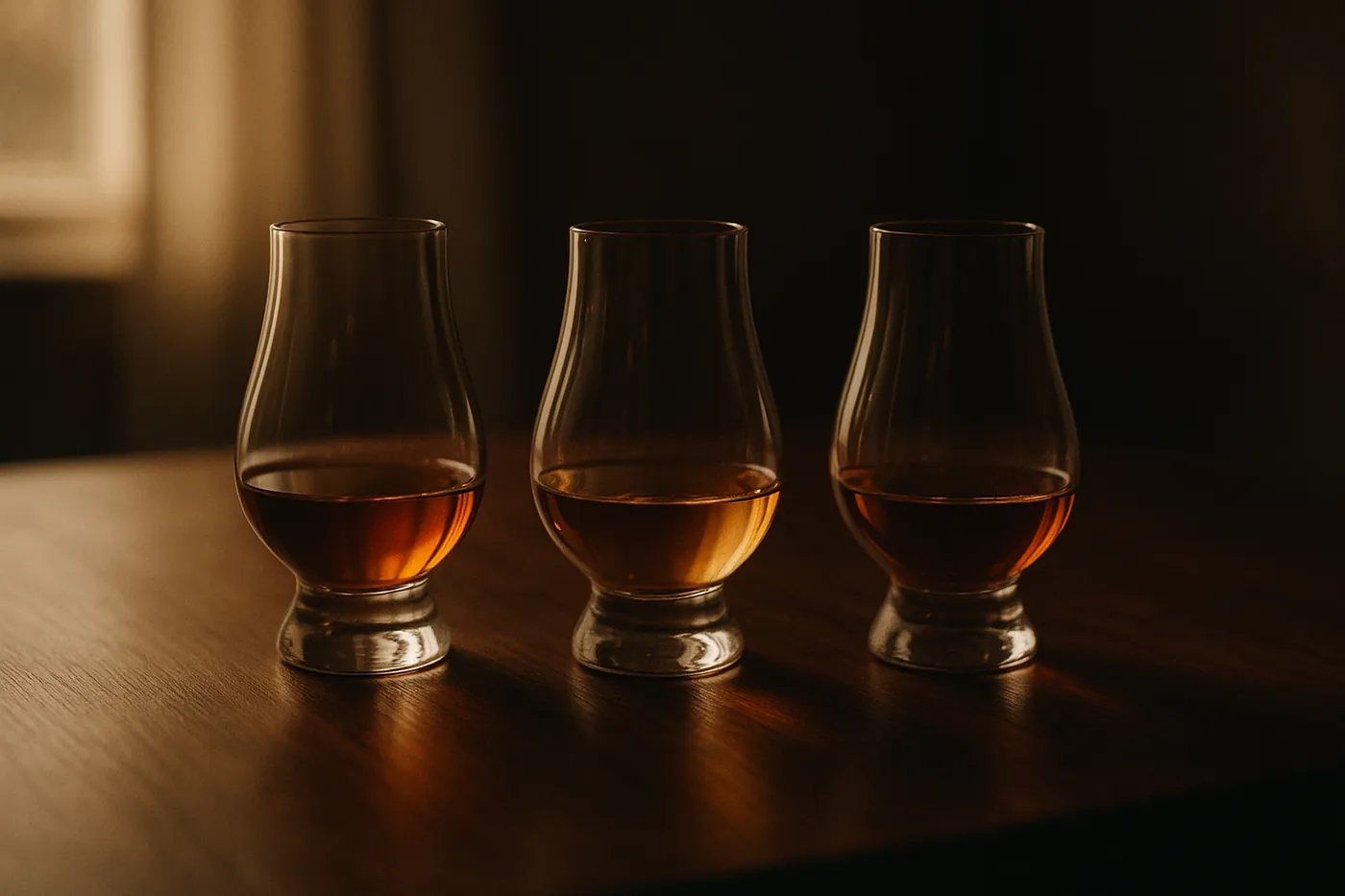
You have a one-in-three chance of being right by luck every single time — whether or not you can smell anything at all. So one right answer means nothing. The question is whether you get enough right, over enough tries, that luck stops being a good explanation.
An exam always gives you a mark. This will sometimes tell you it cannot say yet.
Try it with your own numbers
No app, no account. Put in what you actually got and this will tell you the truth, including when the truth is “not yet.”
The second number: do you agree with yourself?
Telling two whiskeys apart is one skill. The other is consistency: the same pour, months later, read the same way. In the app, one mystery pour in six is secretly a whiskey you already read — you only learn that after you file. The two reads are then scored against each other: did the same flavor families answer, and did the measures land in the same place on a 15-point ladder?
The standard to train toward is 95 — same families, same measures. Exact words are tracked separately and held to no standard at all: nobody, professionals included, repeats a word list at 95%, and a bar nobody can meet only manufactures failure. Families and measures are the skill; the words are the stretch.
A worked example. Your first read of a pour filed sweet, woody, spice, with heat 9 and body 7. Months later its coded repeat answers sweet, woody, heat 8, body 7. The families agree on two of the three named (67). The measures sit one step apart on the 15-point ladder (93). Averaged, that repeat scores 80 — a solid read, still short of the 95 standard. Notice nothing graded your words; the check is whether the same palate showed up twice.
The rules we hold ourselves to
We stay silent below 18 trials
Under 18, Savorant will not call a result at all — it tells you to run more. Same rule in the app as on this page.
This is the part that separates a measurement from a grade. A tasting exam has to produce a mark at the end of the sitting, because that is what the candidate paid for. We are not selling you a verdict, so we can afford to withhold one until it means something.
The number of trials is fixed before you start
You cannot keep going until you get a result you like. That is the most common way this kind of scoring goes wrong, and if we allowed it, the number we showed you would be decoration rather than a result.
We use the exact binomial, never an approximation
The shortcut most people reach for is unreliable at the small numbers one person actually produces at a kitchen table. We compute the exact probability instead.
Two honest limits
A triangle test tells you about those two whiskeys. In that room, on that night. It does not tell you that you can tell whiskeys apart in general.
You are one person, not a panel. Sensory labs run this test across 24 to 60 assessors, and the published thresholds are built for panels. Your Tuesday nose is not your Saturday nose, and a single person's record has to be read with that in mind.
That is the whole method. If you think we have it wrong, we would genuinely like to know: palate@savorant.com.
Still to come on this page: a named sensory scientist’s review of this method, with their name and the date. We would rather publish the method now and add the review than claim a review we have not had.