The curriculum
Ten families. 35 units.
Four levels.
The whole syllabus, in the open: what Savorant teaches, in what order, and what it costs. (Why the method works is its own page.)
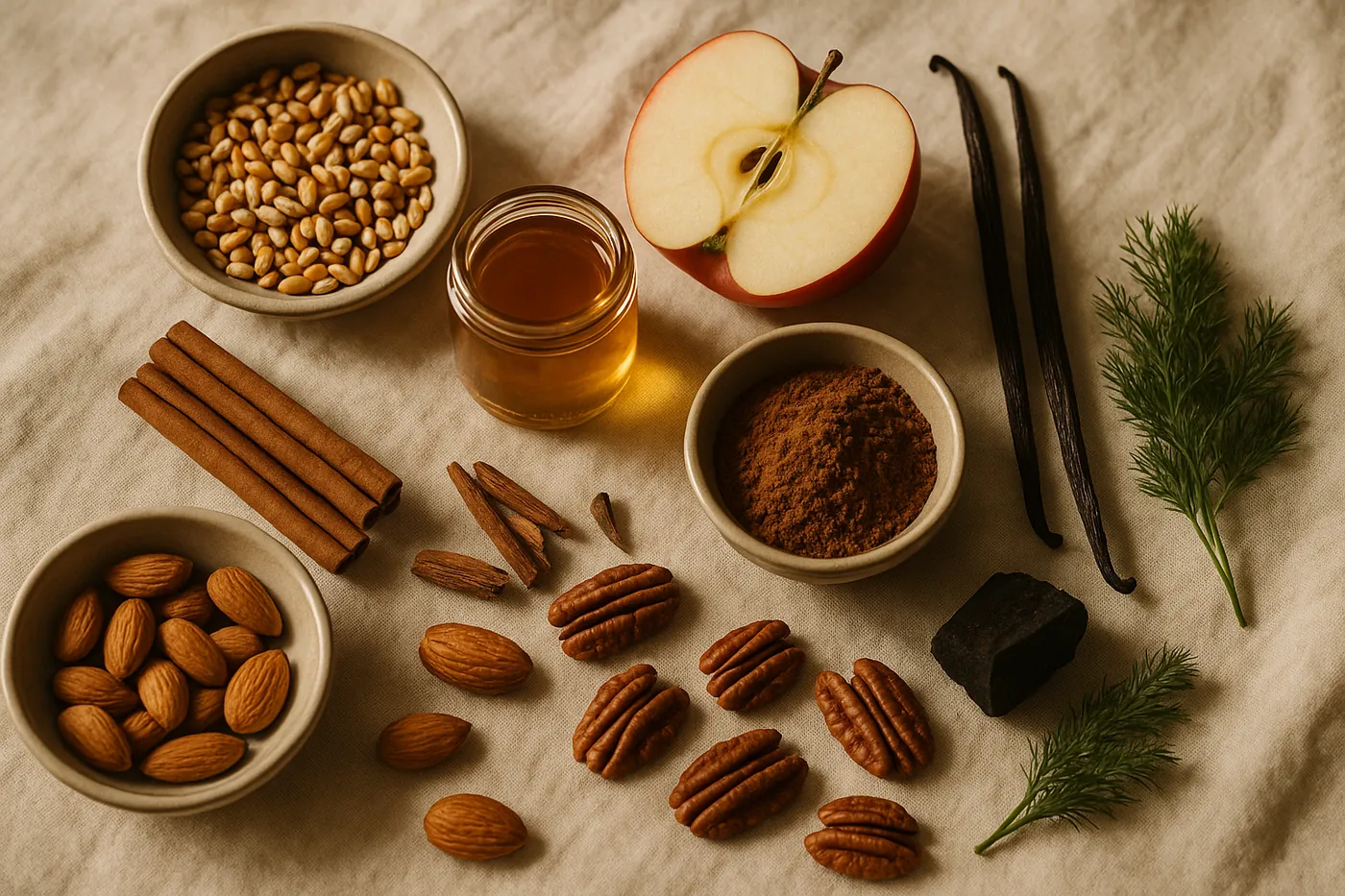
The ten families
Every whiskey word lives in one of ten rooms, and every room is anchored to something you can buy at a grocery store. These are the doors the course opens, one by one:
- Sweet — caramel, vanilla, honey, maple
- Fruity — cherry, banana, blackberry, orchard fruit
- Floral — honeysuckle, rose, violet, chamomile
- Herbal — dill, mint, black tea, culinary herbs
- Spice — cinnamon, clove, black pepper, root beer
- Woody — toasted oak, cedar, coconut, aged oak
- Nutty — pecan, almond, walnut, hazelnut
- Grainy — corn, rye, malt, wheat
- Earthy — leather, tobacco, mushroom, wet stone
- Smoke — charcoal, wood smoke, smoked meat
The course: 35 units, at your pace
Two levels are live. Level 1 — The Ten Families opens each door with a real session: kit named before you start, every stage walked, the word said unaided until the family files itself. Level 2 — The Instrument adds structure — heat, body, finish on a 15-point ladder with real-world calibrators — balance, the deeper vocabulary, and the hard blinds. Most units run 15–30 minutes; you pick 2–5 days a week, and the course counts days, never dates — miss one and nothing breaks.
The ladder: four levels of standing
Separate from the course, your level moves by what’s on your record — words said unaided in real sessions, never a quiz score:
- 1 · The Ten Families — find each family in a real glass.
- 2 · The Instrument — grow to 40 distinct words.
- 3 · Deep Words — 90 distinct words, the fine grain inside each family.
- 4 · The Library — the full vocabulary is yours; the work becomes keeping it sharp.
What you actually do
- A guided session. Pour something you already own. Savorant walks you through it one step at a time and you say what you find, in your own words. Nothing here is a quiz you can fail.
- Ten families of flavor, each with grocery-shelf anchors so you can learn them for real. Smell the apple, then look for it in the glass.
- Ninety seconds a day. Three smells, said out loud. The saying is the part that works — a name only helps if it is there when you learn a smell and again when you try to recall it.
- A course of 35 units, in order, each naming the kit before you start. Oversteeped tea for oak grip. A square of 90% chocolate for bitter. Three drops of water for proof.
- Blind tests. Three glasses, two the same, and you say which is different.
- Your numbers. The words you have earned, how far your ratings sat from the reference, and whether you agree with yourself over time.
What it will not do
It will not improve your sense of smell. Training changes what you can name and tell apart — not the hardware. Most of the research on smell training studied people recovering lost smell, not healthy drinkers, and nobody has studied whether an app like this one works.
Your blind-test record would be the first data of its kind. We will publish what we find. Here is the research, including the studies that cut against us.
How this differs from a course or a certificate
A tasting qualification teaches you a method for describing a spirit, then examines whether you can describe one accurately and argue your way to a conclusion about its quality. That is a real skill, it is worth having, and a human examiner marks it — once, at a sitting.
Savorant asks a narrower question and answers it with arithmetic: can you tell two whiskeys apart when nobody tells you which is which — and can you still do it in March?
An exam always produces a mark. It has to; that is what the candidate paid for. Savorant will decline to give you a result at all until there are enough trials for one to mean something. That refusal is the method, and it is the clearest difference between a measurement and a grade.
Savorant is not a credential. There is no certificate here and no accrediting body behind us. If you are working toward a qualification, this is where you practise between the classes and find out whether the method is working on your nose.
What’s free
Unlimited guided sessions, all ten flavor families and their lessons, the daily ninety seconds, your complete tasting record, and the first six of the 35 course units. You can use Savorant and never pay us.
What costs money
The rest of the course, the blind engine, the drills, and the numbers. $29.99 a year, or $69.99 once. Everything is open for the first 30 days — no card, nothing to cancel. When the 30 days end, Savorant becomes the free version and keeps every word you filed.
Every spirit we add is included. Always.
21+ · United States only, for now. Savorant never sells or delivers alcohol. Sessions are built around one small pour — professional tasters spit, and so can you.
Not ready yet?
Savorant is not on the app stores at this moment. If you want to know when it is, or you have a question, write to palate@savorant.com and a person will answer.