No app required
Start here, with one bottle you already own.
Everything on this page works tonight, with what is already in your house. Take it and use it whether or not you ever install anything.
Smell the real thing first
This is the whole trick, and almost nobody does it — relating a food you already know to the flavor in the glass is how a nameless note becomes a known thing. Before you pour, smell something ordinary and name it out loud — a sliced apple, a jar of cinnamon, a piece of leather, cold black tea. Then go to the glass and look for that one thing.
Hunting for one named smell you have just met is a completely different task from “what do I get?” — which is an open question with no handle on it, and the reason most people freeze.
Say it out loud
Out loud, not in your head. A name only helps you if it is there when you learn a smell and there again when you try to recall it. Saying it is what puts it in both places.
Use ordinary words. “Cherry cough syrup” is a better tasting note than “dark stone fruit” if cherry cough syrup is the true answer.
The ten families
Every whiskey word lives in one of ten rooms. When you are stuck, do not reach for a word — reach for a room, then look inside it.
- Sweet — caramel, vanilla, honey, maple
- Fruity — cherry, banana, blackberry, orchard fruit
- Floral — honeysuckle, rose, violet, chamomile
- Herbal — dill, mint, black tea, culinary herbs
- Spice — cinnamon, clove, black pepper, root beer
- Woody — toasted oak, cedar, coconut, aged oak
- Nutty — pecan, almond, walnut, hazelnut
- Grainy — corn, rye, malt, wheat
- Earthy — leather, tobacco, mushroom, wet stone
- Smoke — charcoal, wood smoke, smoked meat
Three things worth knowing about the glass
- A small pour is plenty. Half an ounce will teach you as much as three, and professional tasters spit.
- The glass changes the answer. A narrow rim concentrates aromatics; a tumbler lets them go. Neither is wrong, but note which one you used — otherwise you will think the whiskey changed when the glass did.
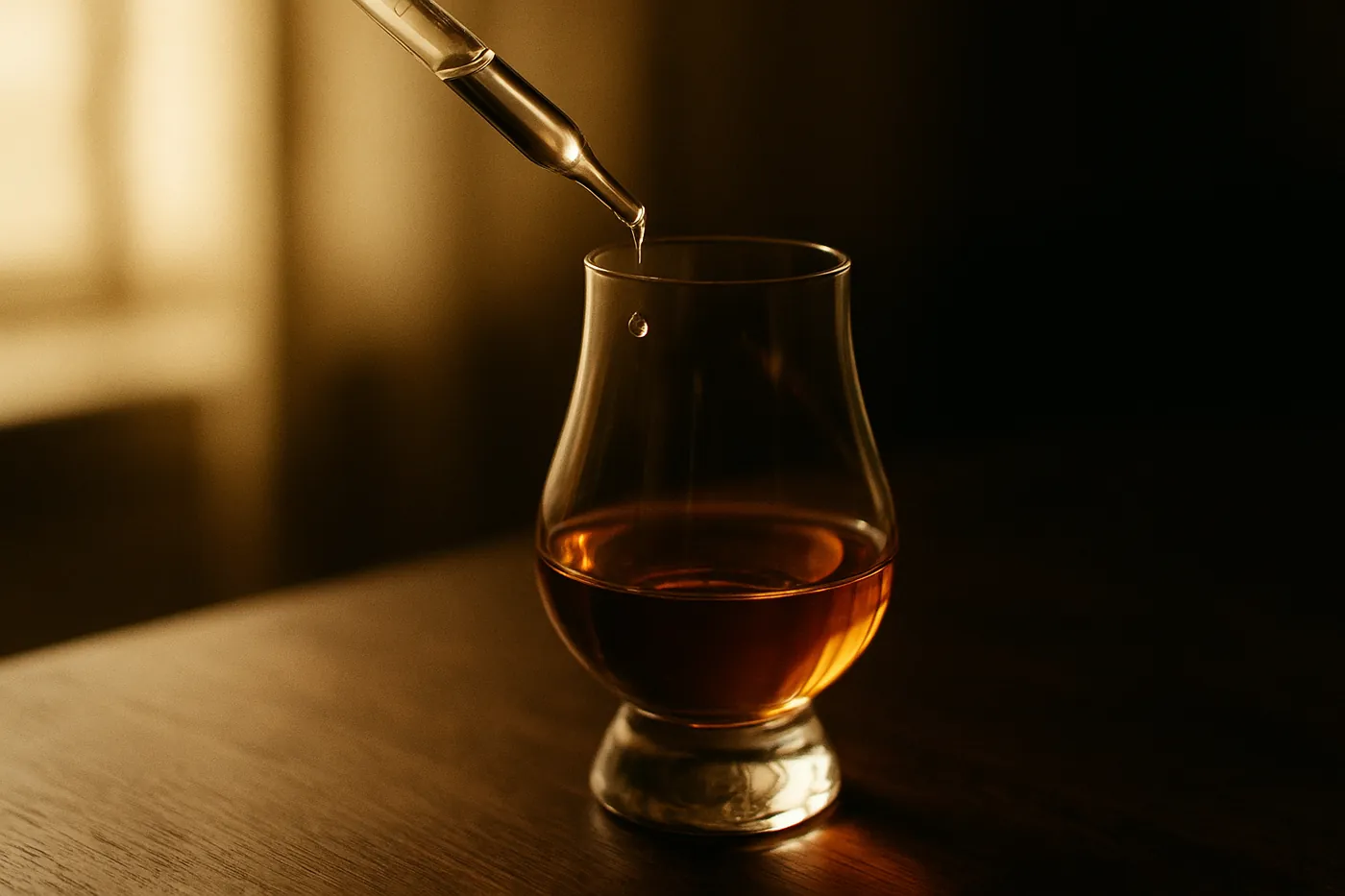
- Three drops of water is an experiment, not a repair. Add them, then read the same whiskey again. It is often two different whiskeys.
Run a real blind tasting for your table
This is the part people find genuinely surprising, and it takes one extra person and three glasses. It is called a triangle test.
- Pick two whiskeys. Similar ones are more interesting than opposites.
- Someone who is not tasting pours three glasses for each taster: two of one whiskey, one of the other. They alone know which is which.
- Vary which glass is the odd one from taster to taster, and do not tell anyone the pattern. Number the glasses 1, 2, 3.
- Everyone tastes all three and writes down which glass is different — not which they liked. Just which one is not like the others.
- Reveal. Count how many got it right.
Now the part that makes it real. Anyone guessing at random gets it right one time in three. So if four of your six guests are correct, that is a fun evening and it means nothing at all — two of them would have landed it blindfolded.
One round is a party trick. A record is a result. Here is how the counting actually works, with a calculator you can put your own numbers into.
If you want the structured version
Savorant is the same method with the homework organized: a session that walks you through every stage, ten families with their grocery anchors, ninety seconds a day, a 34-unit course, and the blind record kept honestly. Here is what it is. The learning half is free and stays free.
It is not a qualification and there is no certificate. A course teaches you to describe a whiskey and an examiner marks it once. This counts whether you can tell two of them apart, on your own bottles, again next month — and stays quiet until the count means something.